News FAST channel automation, end to end
"Automation" gets used loosely in this market. Most tools automate one stage — finding a clip, cutting a clip, scheduling a clip — and leave the handoffs to a person. This page describes what automating the whole chain actually requires, and where the work really is.
The five things a news channel has to do, forever
A 24/7 news channel is not a content problem, it is a repetition problem. Every day, without exception, somebody has to:
- Find the stories across whichever wires you subscribe to, before their rights windows close.
- Write them — a script that matches the pictures, in the channel's voice, at the right length.
- Voice them, consistently, in a voice viewers will accept for hours at a time.
- Assemble them into segments with the channel's own furniture around them.
- Deliver them to a playout platform in a shape it can schedule and monetise.
Miss any one and the channel stops. That is why these channels are usually staffed rather than automated: the manual version is obvious, and the automated version has to work every single day.
Where partial automation breaks down
Automating one stage moves the bottleneck rather than removing it. A tool that finds clips brilliantly still leaves someone writing and voicing them. A tool that generates social clips from your newscast presupposes a newsroom making a newscast. And a scheduling system, however good, cannot schedule a file that arrived with no duration and no ad breaks declared.
The handoffs are where the labour actually accumulates: downloading and renaming, pasting between windows, re-uploading, and reconstructing from a filename what a clip was supposed to be. In a manual pipeline the copying and pasting is a real fraction of the day.
What end-to-end automation looks like in practice
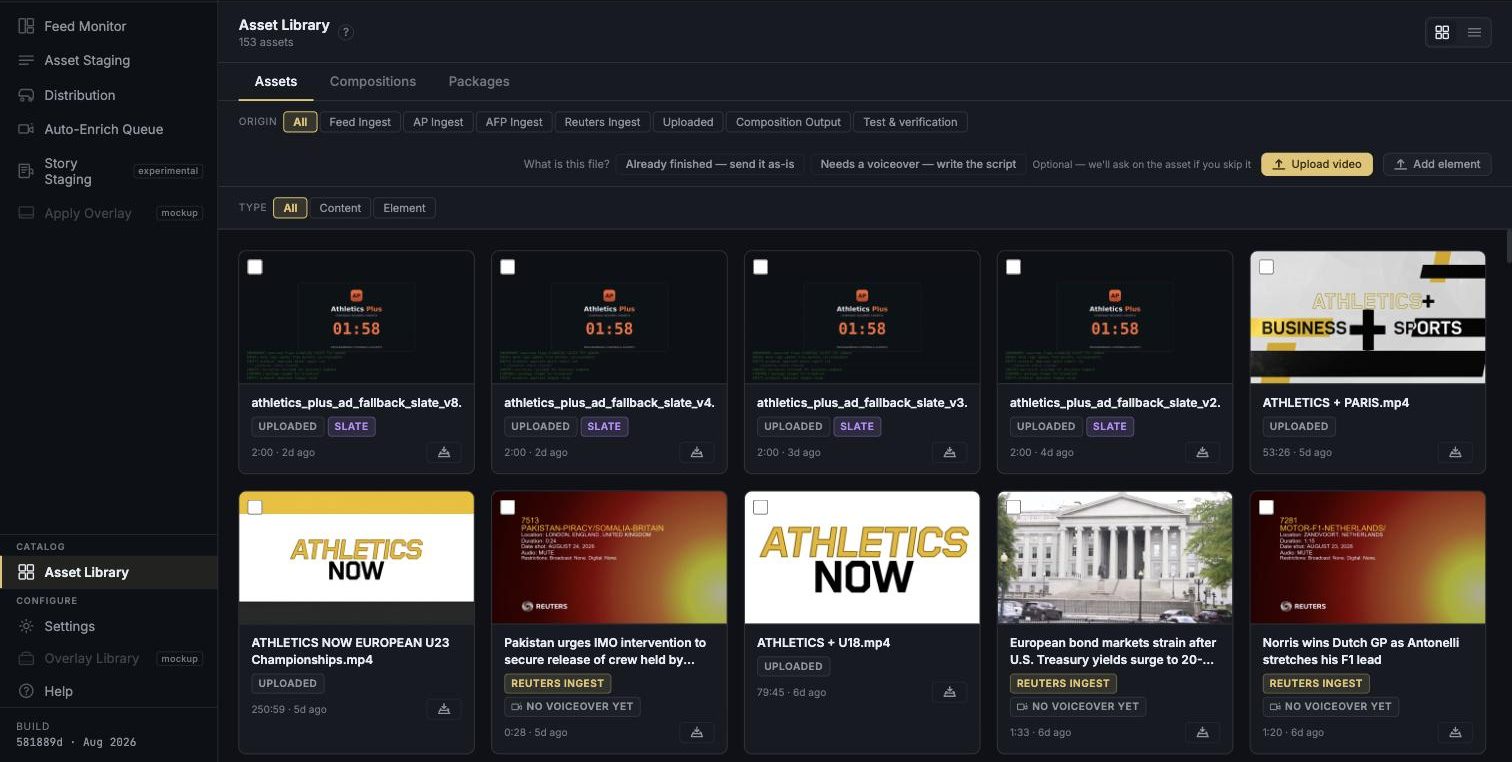
MediaBlaze is built as one pipeline rather than five tools. A clip arrives from AP, AFP or Reuters into a single monitor and is staged with one click. An operator writes a shot list — the human judgement about what the story is. From that, a script is written, a voiceover recorded and the audio mixed under the narration. The run then stops, and waits for an editor. Approved clips become segments on a timeline, get ad-break cue points, and are delivered as a package plus a feed entry the playout platform polls.
The operator's day becomes writing shot lists and approving output — the two tasks that genuinely need a person who knows the channel.
What automation should not do
The loudest public objection to AI in news is not that it is inaccurate — it is that it reproduces journalism without permission. Any honest automation pitch has to answer that rather than route around it.
Two answers matter. First, the footage is licensed: it arrives under an agency contract the operator holds and pays for, and the software neither licenses nor resells it. Second, no clip reaches air unattended — the enrichment run halts before mixing, approval is what creates a package, and delivery asks again. An automated pipeline with a human gate at the one irreversible point is a different thing from an autonomous one, and the difference should be visible in the product, not just the marketing.