Cue points a playout system can act on
This is the least glamorous page on this site and the one that decides whether a channel earns anything. A file handed to a broadcast platform with no declared breaks earns you no advertising, because the playout system has nothing to fire against. Getting this right is most of the last mile.
Breaks are pre-filled, not left empty
An asset that starts with no breaks marked is an asset somebody has to remember to mark. So the moment MediaBlaze knows how long a clip runs, it seeds a cue point every eight minutes and opens the panel pre-filled. You adjust or delete — you never start from a blank bar.
- The four-minute minimum is enforced, because it is the platform's rule. A break placed too close is refused with the reason quoted, rather than accepted here and rejected at ingest.
- Marked on the clip, not the timeline. Ad breaks belong to the asset, so they survive being re-composed.
- Unmarked is still allowed. The package warns you, loudly, and lets you send anyway — there are legitimate reasons for a segment with no breaks.
Both halves, paired on the filename
Every delivery is two things: the video, uploaded into the storage the platform watches, and an entry in a feed it polls, describing what the file is, how long it runs and where the breaks fall. They are matched on the delivered filename. A file with no entry behind it does not air.
- Pre-flight before you send — bitrate, resolution, audio sample rate, scan type, checked against the platform's published limits. Findings are blocking or advisory, and a blocking one can be overridden deliberately.
- Detection, not repair. The check never re-encodes anything behind your back. It tells you; the fix is yours.
- Confirm before air. Delivery cannot be recalled, so it asks once, plainly, and the confirmation is not a formality.
- A timed delivery log — dispatch, load, resolve, download, upload, finalize — so a failure names the step it failed at instead of just going red.
- Withdrawing is not deleting. It removes the feed entry; the file stays in the platform's storage and anything already scheduled still airs. We say so rather than implying a recall.
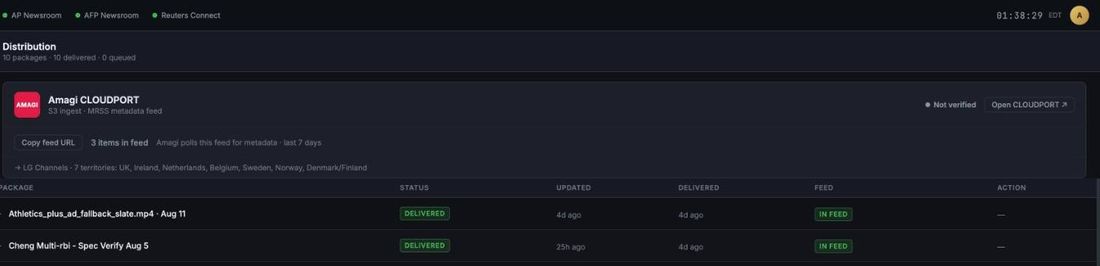
Five states, and none of them lie
Waiting is not running
Queued means sent off and waiting its turn — the upload has not started. Delivering means it is happening now. Collapsing the two would make a stuck queue look like progress.
A failure keeps its evidence
A failed delivery does not vanish into a red badge. The package stays, the error stays on its last delivery event, and the control becomes Retry delivery.
Stalled work says so
Work that has sat too long is surfaced as possibly stalled rather than spinning quietly forever. It is inferred from timestamps, so the hedge in that wording is deliberate.